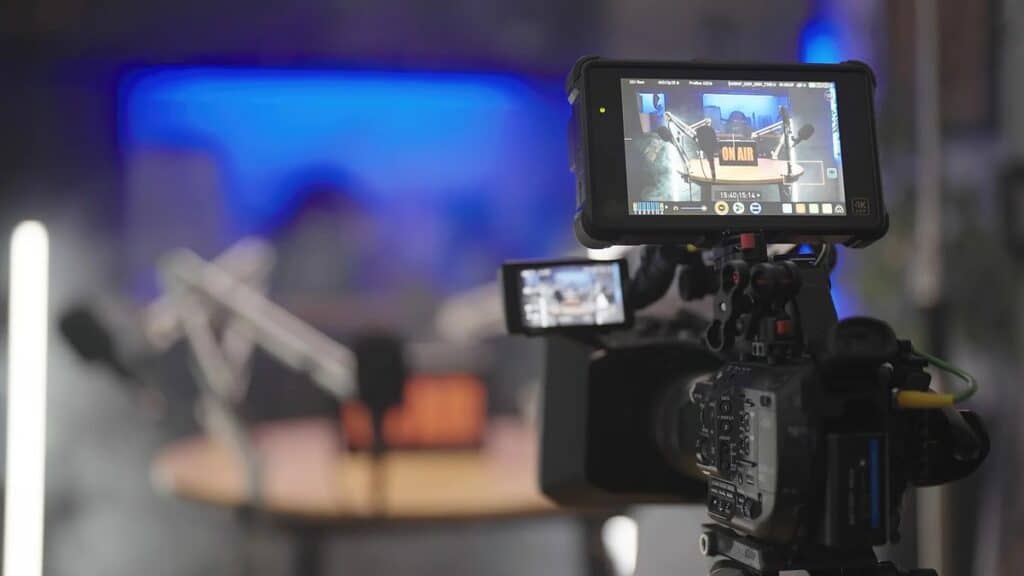
There are creators who record an entire podcast as a video, edit it to perfection, and then never publish it. The podcast exists solely as source material for clips. That sounds bizarre. It isn’t.
Video started out as a promotional tool. It hasn’t been that for a long time now.
A few years ago, the logic was simple: you record a podcast, cut out a tantalizing snippet, post that snippet on social media, and use it to draw people to the full episode. Video as a gateway to audio.
Until it turned out that those short clips reached more people on their own than the podcast itself ever could. The reach of a well-edited clip on LinkedIn or Instagram can be many times greater than the number of listeners to the original episode. That changes the equation.
Since then, creators have been thinking in two directions at once: the long-form listening experience for those who are truly engaged, and the short-form viewing experience for those who still need convincing. A video podcast serves both purposes with a single recording.
People watch podcasts. On their televisions.
That may sound contradictory, but the numbers speak for themselves. YouTube announced that the number of hours people spend watching podcasts on their TVs has nearly doubled in a single year, reaching over 700 million hours in a single month. Not on their phones. On the big screen in the living room.
In the United States, YouTube is now the most widely used podcast platform, surpassing Apple Podcasts and Spotify. Spotify has already responded to this trend: the platform now offers more than 330,000 video podcasts. Episodes with video are watched for longer than those without. That’s no coincidence. That’s user behavior.
Podcasting and video are no longer two separate disciplines that just happen to overlap. They have become a single production process with multiple formats.
Visuals do something that audio alone cannot
The most obvious way to use video in a podcast is to point a camera at two people talking. That works, but it doesn’t come close to making the most of the medium.
What video adds when you think about it carefully: a visual recap of the key points as the speaker explains them, a highlighted quote just as it’s mentioned, an infographic that appears when the context calls for it. Not as a distraction, but as reinforcement. The ear and the eye process information simultaneously, making the content easier to understand and more memorable.
What’s more, these elements are reusable. The same quote that appears on screen during filming also works as a standalone clip on LinkedIn. The same infographic that viewers understand also serves to explain something in a Reel. A single decision made in the studio yields multiple pieces of content without requiring additional production time.
When audio-only is still the right choice
Video isn’t the starting point for everyone. There are situations where audio-only is just right.
If your format revolves around intimate conversations where a camera would disrupt the flow. If your audience mainly listens on the go—in the car or with earbuds while working out. If you want to get started quickly without the extra production steps of lighting, framing, and editing. If your content is timeless and discovery through platforms like Spotify or Apple Podcasts is sufficient for your needs.
I’m writing this as someone who spent years performing as a “Piano Man” in restaurants and at weddings. Just a piano—no camera, no YouTube channel. It worked perfectly. But I’m not selling a 2009-style strategy anymore.
Audio-only isn’t an outdated choice. It’s a different choice, with different advantages. The only question is: is it the right choice for what you want to achieve?
How do you choose?
The answer depends on two things: your audience and your distribution strategy.
If your audience mainly listens on the go and your show thrives on Spotify or Apple Podcasts, audio-only is perfectly fine. But if you want to be discovered on YouTube, create clips for LinkedIn or Instagram, or ensure your show appeals to people who’ve never heard of you before, then video isn’t a luxury—it’s the logical choice.
For organizations that take content seriously, the question has now been turned on its head: it’s no longer “Should we add video?” but “Why would we leave it out?” Both of Big Orange’s studios, in Utrecht and Amsterdam, are fully equipped for 4K video podcasts. The choice doesn’t have to be a difficult one.
Not sure which format is right for your organization? Send an email to studio@big-orange.nl. We’d be happy to help.
Jos Jansen is the founder and Creative Audio Director of Big Orange. He studied music technology, plays guitar on Spanish beaches during his vacations, and organizes annual sing-alongs for a few hundred people at a time. He writes about podcasts, audio, and the effects of sound on people.